
the Handmade Art of Yixing Zisha Teapots
Every piece you see here is carefully shaped by hand - true Yixing purple clay art. Every piece has passed through the critical eye of a master. We are so grateful for your continued support of our craftsmen and artists who patiently wait for the kilns to reward their efforts.
Our fully handmade pots require an artist's time: three days of work, and are then fired not once but three times, each firing requiring an extra day. Our semi-handmade products still take professional craftsmen about a day and a half to shape and undergo three separate firings.
With all this meticulous work, the average success rate hovers around 70%.
About fully handmade and half handmade
Among the vast world of tea wares, the Yixing zisha (purple clay) teapot has long been revered as the "crown of tea vessels." Its esteemed status comes not only from its celebrated dual-pore structure — breathable yet watertight — but also from the exquisite handcrafting techniques passed down through generations. Among seasoned tea lovers and collectors, a consensus has quietly formed: authentic Yixing teapot craftsmanship ultimately comes down to just two legitimate methods — fully handmade and half-handmade.
However, many newcomers mistakenly equate "half-handmade" with "machine-made" or even "fake," confusing it with slip-cast pots or wheel-thrown pots. Today, let’s clear away the fog and explore the authentic story, the spirit of craftsmanship, and the mark of the times behind these two genuine traditions.
I. Tracing the Roots: From Carved Wooden Molds to Shi Dabin’s fully handmade
The comparison between fully handmade and half-handmade methods was essentially inscribed in the very birth of the zisha teapot.
As early as the Zhengde period of the Ming Dynasty (1506—1521), Gong Chun, the founding father of zisha, was already "carving wood to make molds," meaning he used wooden inner molds to shape his pots. Then came the great master Shi Dabin (click to know more). According to historical records, he "understood the method and then abandoned the mold." While he set aside wooden models, he sharpened bamboo to create an entirely new set of tools dedicated to pure hand-building, laying the foundation of the fully handmade paddle-beating technique that defines Yixing pottery.
Beyond artistic evolution, a historical watershed also determined the direction of the craft. According to the research of zisha master Xu Xiutang 徐秀棠 (click to know more), the year 1957 marks a crucial dividing line. Beginning in 1958, mechanization entered the mining and processing of clay. In that same year, the plaster mold shaping technique was officially introduced to Yixing. To standardize product specifications, increase output, and meet the demands of a modern market, the "half-handmade" method was promoted on a large scale by the Yixing No.1 zisha Factory (click to know more).
II. Fully Handmade
The fully handmade pot represents the very pinnacle of zisha artistry. This does not mean molding clay with bare hands alone; it refers to the technique of paddle-beating and joining slabs on a wooden turntable — a method preserved from the Ming Dynasty, using only traditional tools made of bamboo, wood, and ox horn.

The artisan must first beat the clay into flat slabs, then shape them into a cylinder. Using a wooden paddle, they apply countless rhythmic beats "from the outside in," infusing the body of the teapot with what is known in Chinese as "jing, qi, shen" — its essence, vitality, and spirit. This craft is extraordinarily demanding. Without the support of any molds, the production cycle for a fully handmade pot is long, and the rate of successful pieces is low, placing extreme demands on the maker’s fundamental skills. Yet precisely because of this, every fully handmade pot is a unique, unrepeatable creation; no two are exactly alike. It bears the warmth of the artisan’s touch, its lines brimming with life and a sense of dynamic fullness. A well-crafted fully handmade teapot with true artistic beauty is a collector’s piece of the highest value.
The video below briefly demonstrates Fully handmade a teapot
The artist of Siyutao is fully handmaking Yixing purple clay teapots
III. Half-Handmade: The Underappreciated Craft
This is the part that most easily confuses newcomers, so let's dispel a fundamental misunderstanding right away: a half-handmade pot is absolutely not a wheel-thrown pot, and it is worlds apart from a slip-cast pot.
The video below briefly demonstrates half handmade a teapot,
You can find that the craftsmanship of half handmade a teapot is also very complicated.
The half-handmade method is also called "press-molding." It does not involve stamping clay with a machine. Instead, the artisan first beats the clay into a rough body, then places it into a plaster mold and carefully presses it outward from the inside by hand to define its shape. Once the body is set, the mold is opened, and the pot undergoes further refinement. Except for the main body, which relies on the mold for precise shape, every other step — the rolling of the spout and handle, the joining of all components, and the immensely skillful "mingzhen" 明针 burnishing — is entirely done by hand.
Its emergence can be attributed to three main reasons. First, the needs of the era. Second, as an aid to artistic expression: for complex designs like Wang Yinxian’s 汪寅仙 famous "Qu Hu" (Curved Teapot), achieving perfect symmetry is almost impossible by purely freehand methods, and a mold becomes necessary to realize the artistic vision. Third, it lowered the barrier to entry, shortening a typical apprentice’s training period from three years to about one or two, allowing more artisans to enter the craft. Half-handmade work falls into the “easy to start, hard to master” category. It is easier to get started, but to achieve true mastery, craftsmen and artists alike must put in years of dedicated effort.
There are also several typical market misconceptions about half-handmade pots that need clarification:
Misconception 1: "With a mold comes a lack of spirit." The truth is, the mold itself is blameless. Masters like Gu Jingzhou 顾景舟 and Wang Yinxian 汪寅仙 used molds for certain works; the essence lies in using them skillfully. Sometimes, a fully handmade pot created by an insufficiently skilled maker falls short in strength and artistic presence compared to a masterfully executed half-handmade piece. Judging value solely by technique category is unreasonable. The focus should be on the form, the aesthetic appeal, and the overall aura.
Misconception 2: "Unlimited production capacity." A half-handmade pot still contains the maker’s thought and intent. Closing the mold, refining the shape, and performing the mingzhen finish all demand substantial handwork; limitless identical reproduction is impossible.
Misconception 3: "It has low value." The value of a zisha teapot lies in its vitality, spirit, and charm. A half-handmade pot with precise lines, harmonious proportions, and a high-level mingzhen finish is not only highly practical but also worthy of collection and appreciation. A roughly made fully handmade pot can be far cheaper to produce and is vastly inferior to a finely crafted half-handmade one.
IV. Incompatible with the Art: Why Machine-Made Pots Are Not True Zisha
If fully handmade and half-handmade methods are the orthodox paths of zisha, then machine-made pots — represented by "ji che 机车 machine pots" and "slip-cast pots 手拉坯" — fundamentally destroy the soul of the clay and cannot be called traditional Yixing zisha teapots.
Authentic Yixing zisha clay has a unique "sandy" character and a dual-pore structure, which makes it impossible to shape rapidly by machine. To accommodate factory assembly-line production, manufacturers have to add chemical additives such as kaolin 高岭土 and water glass to the clay, grinding it into an ultra-fine slurry. The consequences of this practice are fatal to the essence of zisha:
Breathability is suffocated: Machine pressing and slip casting completely seal the teapot’s pores. The walls become lifeless like glass, forfeiting the life-giving ability to be "breathable yet watertight," which will stifle the tea liquor while brewing.
Handmade traces are lost: The inner wall of a machine-rolled pot shows only cold, regular mechanical marks. Slip-cast and wheel-thrown pots have no telltale seams of hand-patted clay slabs, completely lacking the rustic textures of handmade artifacts.
The clay is degraded: To achieve an artificial shine, some machine-made pots incorporate metallic oxide.
For these reasons, within the traditional zisha community, wheel-thrown or machine-rolled pots are still not recognized as genuine expressions of zisha forming techniques.
Fully handmade teapots represent the depth of Yixing zisha — the summit of art collecting and artistic creation. Half-handmade teapots represent its breadth, offering higher cost-effectiveness and more standardized quality, bringing the art of zisha to the tea tables of ordinary households.
The soul of a true zisha teapot does not rest in whether a mold was used, but in whether the artisan poured their heart into it, whether the form is graceful, whether its presence is noble, and whether the clay preserves its earthy breathability. For tea lovers, what matters most is not stubborn attachment to a particular forming method, but simply to savor, in the time it takes to brew a fine pot of tea, the gentle warmth and quiet composure born from the marriage of water and fire.
What Siyutao provinding
Siyutao specializes in the crafting and curation of Yixing zisha teaware, offering two types of handmade zisha teapots,fully handmade and half-handmade,alongside a curated selection of exquisite tea cups. We maintain our own inventory of authentic Yixing raw ore clay and remain committed to traditional, hands-on methods of preparation Gu Fa Lian ni, ensuring the clay stays pure and natural.


The raw Yixing zisha clay goes through a series of intricate, time-honored steps before it is ready to be shaped. It is blended with water, left to air-dry in the shade, pounded to refine its texture, and then set aside for a long period of aging (chenfu). This natural process allows the clay to develop perfect plasticity and rich character, ensuring that it remains pure. (click to know details)
Siyutao's excellent authentic pure Yixing purple sand (zisha) clay & Gu Fa Lian Ni(古法炼泥) most ancient way to make the clay by hand
In 1885,Ren family began to continuously collect unique Yixing raw mineral ore ,
and established our own Yixing clay workshop and raw Yixing clay minerals warehouse.
To this day, we have 23 large ore warehouses and 76 clay cellars.
Through studying the rich color variations produced from different proportions of Yixing clay from different ore mines.
We only use the purest and best raw ore of authentic Yixing purple sand (zisha), and only add water in the process of making clay, without adding any chemicals.
In this era of rapid industrialization, we still choose to keep the ancient craft of making clay by hand (Gu Fa Lian Ni 古法炼泥) for excellent quality.
Machine-made Yixing clay does not have a more breathable clay mass, and its surface grain structure is not as beautiful as hand-made clay. It is an accepted fact of the industry that handmade clay (GuFaLianNi 古法炼泥) is expensive and does not appear on the open market. The complexity of the clay-handmaking process and the high demand for the quality of clay ore and superb manual skills in Yixing have led most artists to opt for machine clay rather than handmade clay.
Below are some simple images of Siyutao’s hands-on process for making Yixing clay. The actual process is more complicated.
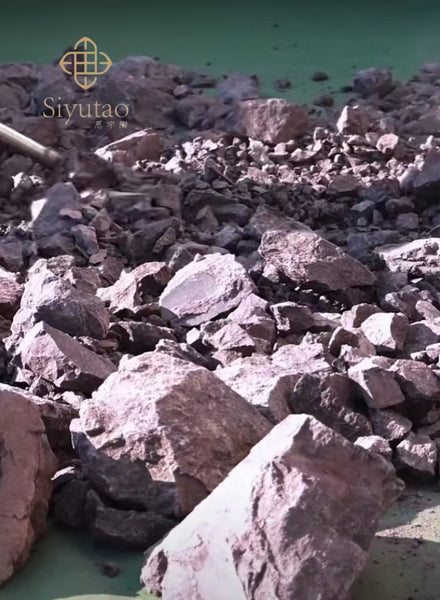
Natural light basks Yixing zisha raw ore
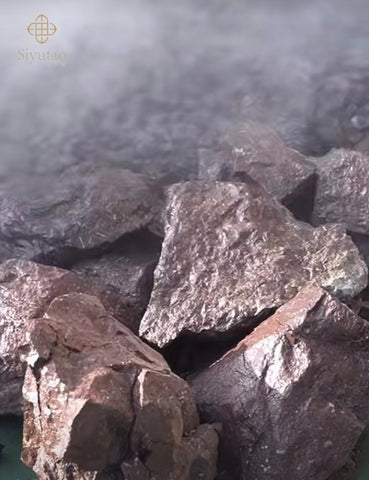
In three to four years,
water is often sprayed on the raw ore of Yixing purple sand (zisha).

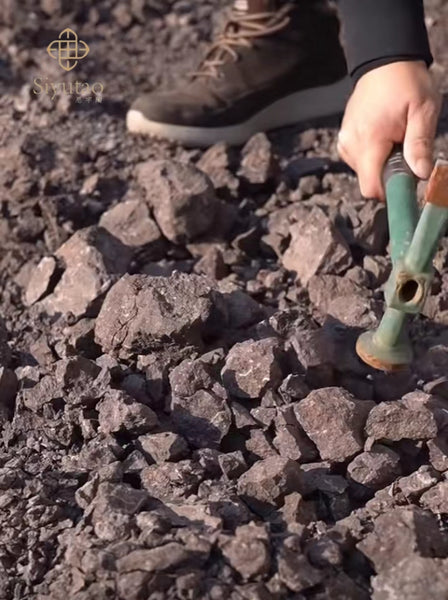
For three months, smashing the ore by hand with hammers.
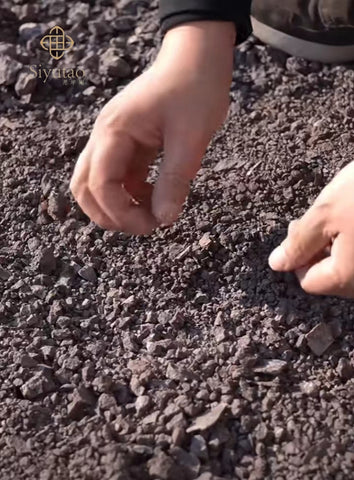
The ore gets smaller and smaller.
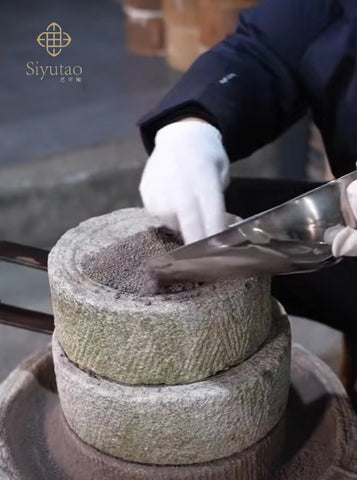
The small ore is pulverized by a hand mill.
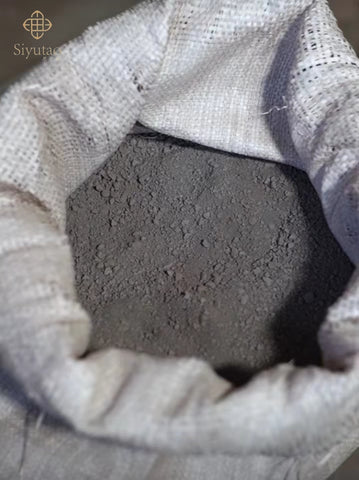
Yixing purple sand ore is ground into powder by stone grinding.
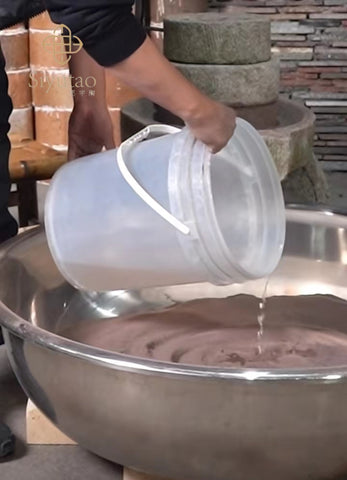
add pure water only
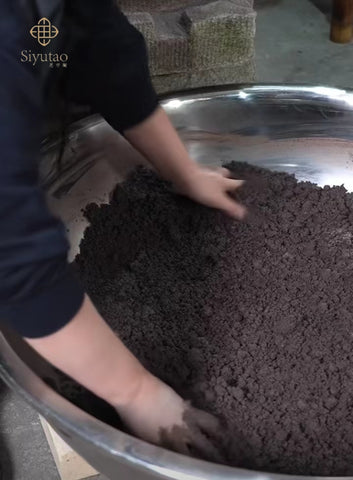
Stir by hand
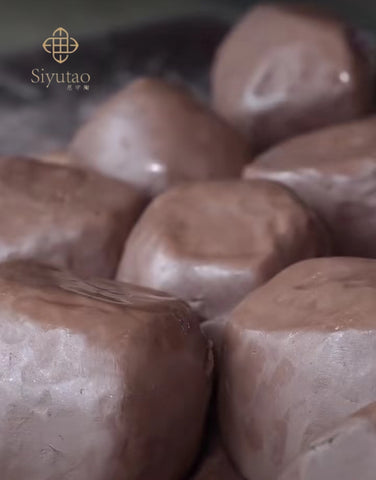
roll the clay into balls
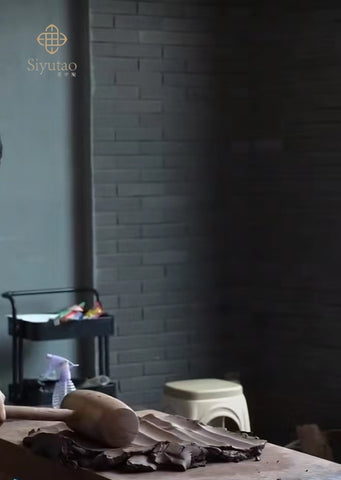
The authentic Yixing clay is repeatedly hammered,
a process that lasts about three days.
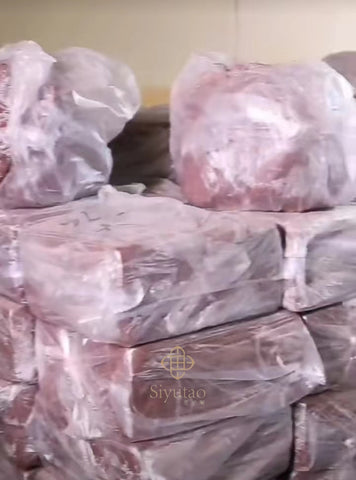
We cut the authentic Yixing clay into large squares and put them in underground cellars for preservation.
This is the beginning of everything.
Siyutao's Yixing authentic purple sand (zisha) clay spends at least 15 years in underground cellars, where time improves the clay, a process known as chenfu(陈腐)
Craftsmen need many complicated processes to make purple sand clay from purple sand ore. The most difficult process to make clay super good is chenfu(陈腐).
The principle is similar to wine aging. The longer it is in the cellar, the better the clay becomes.
Siyutao is proud that from the 1880s days of the Qing dynasty, we had built ore warehouses, clay workshops and clay cellars. So far there are 23 large ore warehouses and 76 cellars.
Siyutao has even preserved a wealth of excellent-quality ore and precious Yixing clay that has been chenfu(陈腐) for 60 or 70 years.

